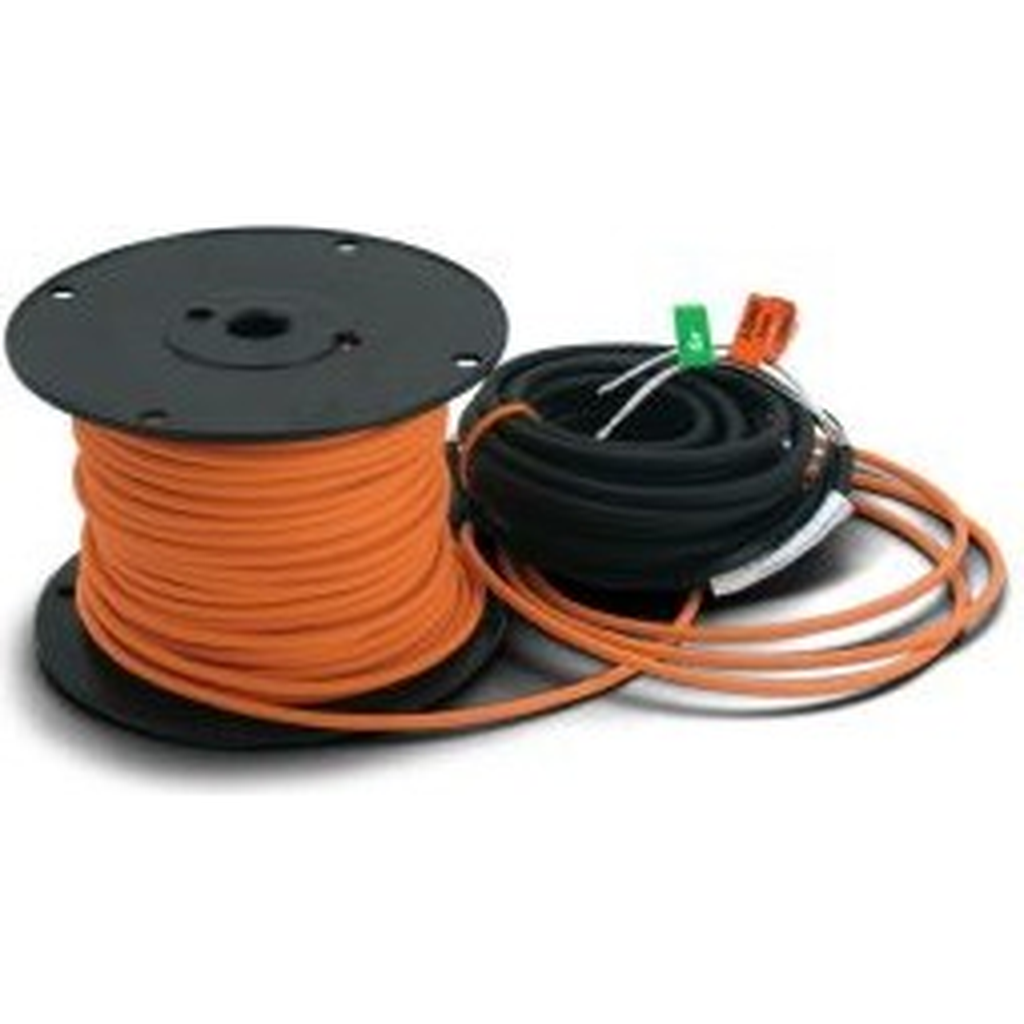
208VAC Snow Melting Cable
ProMelt Cables cost less than ProMelt Mats and give you more layout
options.
In both products, the heating elements are surrounded with the same
high-temperature ETFE and engineered polyurethane outer jacket for long life
and jobsite toughness, including installation in asphalt. ProMelt Cables are
usually tied to reinforcing wire 3 or 4 inches on center. That
provides either 50 or 38 Watts per square foot. ProMelt Cable
can go perimeter to perimeter or fill odd-shaped areas for complete snow
melting coverage.
There are a lot of ProMelt Cable sizes in stock in four single-phase voltage
options. All the cables terminate at one end with a power lead so you only
make one connection to your electrical source.
ProMelt Cables save on material costs, give you more flexibility and carry a
10-year limited warranty.
Follow these recommendations when selecting ProMelt Cables:
- Determine what voltage will be used:
- 120V, 208V, 240V, or 277V.
- Determine the heat output.
- The climate and amount of snowfall will dictate this choice. In
general, most systems will require 50 Watts/Sq.Ft. spacing (3” o.c.)
to melt snow and ice. Some residential or light commercial systems in
temperate climates, may need only 38 Watts/Sq.Ft. spacing (4” o.c.).
- Determine the square footage of the area to be melted.
- Do not include areas under built-ins like planters or similar
obstructions. Stay 3-6” from edges of slabs and do not cross expansion
joints if possible. Add up all the areas to be melted
- and round down to the nearest cable size(s) to fill the area.
Alternatively, you might want to figure the total length of cable needed.
This can be better for an area such as tire track melting. As an example, a
24”-wide track with 3” o.c. ProMelt Cable will go back and forth eight times
to fill a 24”-wide track. If the tire track is 25’ long, then each track
will need 8 lengths x 25 feet or a total of 200 feet of cable.
More than one cable can be used to melt an area. Combine cables in a manner
not to exceed the capacity of the electrical control selected. If using our
ProMelt ContactorPro controls, each area should not exceed 50-amps, since
these controls are built with 50-amp contactors. Therefore, we recommend
dividing the area(s) into “sub-zones”, if necessary or desired, to minimize
the cable amp load connected to each contactor.
Listing: ETL Listed for U.S. and Canada under UL 515, IEEE 515.1, and
CAN/CSA C22.2 No. 130-03 Listing file number: 3151992